
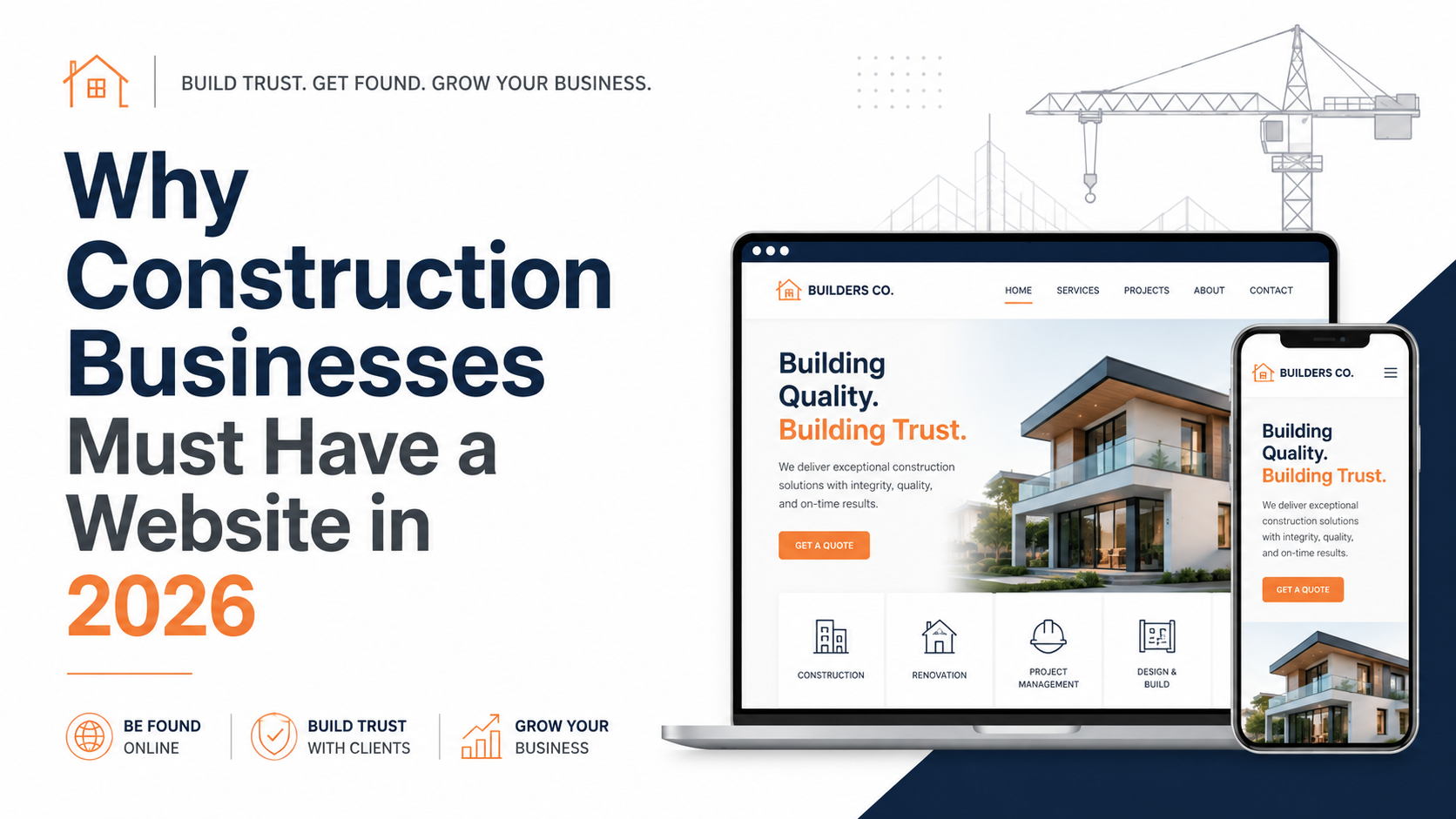
Why Every Construction Company Must Have a Website in 2026
In the past, construction companies could grow mainly through personal recommendations, site boards, local connections, and repeat customers. Those methods still matter, but they are no longer enough.
In 2026, a construction company without a professional website is difficult to discover, difficult to verify, and easier to ignore. A website is not simply an online brochure. It is your company’s digital office, project portfolio, credibility system, lead generator, and sales representative—working every day, even when your team is unavailable.
1. Customer attention has moved to the phone
People now use their phones to search for contractors, compare companies, view completed projects, check locations, read reviews, and request quotations. By April 2026, more than 6.1 billion people worldwide were using the internet. (DataReportal – Global Digital Insights)
Google also primarily uses the mobile version of a website when indexing and ranking its content. This means a construction company needs more than just a website—it needs a fast, clear, mobile-friendly website. (Google for Developers)
When someone hears your company’s name, sees your advertisement, or notices your signboard, their next action is often to search for you on their phone. What they find will influence whether they contact you or choose another contractor.
2. Word of mouth starts the conversation, but your website confirms the decision
Word-of-mouth marketing is powerful because it creates trust. However, recommendations usually reach only a limited number of people.
Even after receiving a recommendation, many potential clients will still search for the company online. They want to know:
Is this company professional?
What kind of projects has it completed?
Does it work in my location?
Can it handle a project of my size?
How can I contact the company?
Is the business active and trustworthy?
A strong website supports the recommendation. A weak website—or no website at all—can create doubt.
Word of mouth may introduce your company, but your online presence often determines whether the customer takes the next step.
3. Construction is a high-trust business
Hiring a construction company is not like buying a low-cost product. Clients may be investing their savings, taking loans, or building a home they have planned for many years.
Before making such a major decision, they need evidence that your company is capable and dependable.
A professional website can display:
Completed and ongoing projects
Before-and-after photographs
Construction processes
Services and areas of expertise
Client testimonials
Team qualifications
Company registration and contact information
Office location
Frequently asked questions
Warranty or after-service information
These details reduce uncertainty. They help a potential client feel that the company is established, organised, and accountable.
Your website should answer the client’s basic questions before your first meeting.
4. A website allows clients to properly understand your work
Social media posts move quickly and are often seen without context. A customer may see one photograph but still not understand the size, location, scope, materials, or challenges involved in the project.
A website allows you to create detailed project pages explaining:
Project type and location
Land or building area
Number of floors
Construction duration
Design style
Materials used
Services provided
Major challenges and solutions
Final outcome
This turns a simple photograph into proof of experience.
Instead of only saying, “We build quality homes,” you can show exactly what you have built and explain how you completed it.
5. You can target specific locations and services
A website helps your company become visible to people who are actively searching for construction services in particular areas.
For example, instead of trying to reach everyone, you can create pages targeting searches such as:
House construction company in Kathmandu
Residential contractor in Lalitpur
Commercial construction company in Bhaktapur
House renovation services in Baneshwor
Turnkey construction company in Nepal
Building design and construction services
Google explains that relevant, well-organised website content makes it easier for search engines to crawl, understand, and present a business in search results. (Google for Developers)
A complete Google Business Profile can also help a company appear in Google Search and Maps, especially for local customers. Google notes that complete and accurate business information improves the likelihood of appearing in relevant local results. (Google)
The strongest approach is to use both: a professional website for detailed information and a Google Business Profile for local visibility.
6. Your website works 24 hours a day
Your office may close in the evening, but potential clients continue researching at night, during weekends, and outside business hours.
A well-designed website can allow visitors to:
Request a callback
Submit project details
Upload land or building information
Book a consultation
Ask for an approximate estimate
Call or message through WhatsApp
Download a company profile
View projects and services
This means your website can collect enquiries even when no employee is available to answer immediately.
Instead of losing the client, you capture their name, phone number, location, required service, approximate budget, and preferred contact time.
7. It brings better-qualified enquiries
A large number of enquiries does not always mean good business. Construction teams can waste significant time answering people who have unrealistic budgets, unsuitable locations, or requirements the company does not provide.
A website can educate and qualify clients before they contact you.
You can clearly explain:
The areas where you work
The types of projects you accept
Your construction process
Approximate starting prices
Project requirements
Expected timelines
Services that are included or excluded
When clients understand these points beforehand, conversations become more productive. Your sales team spends less time answering repeated basic questions and more time speaking with serious prospects.
8. A website helps you compete on value, not only price
Without a strong online presentation, construction companies can appear similar. The client may then compare them only by quotation amount.
A website gives you space to explain why your company may be the better choice.
You can communicate your advantages, such as:
Better project supervision
Transparent cost reporting
Qualified engineers
Proper documentation
Quality-control procedures
Regular client updates
Reliable timelines
Safer construction practices
After-construction support
When clients understand the value behind your service, they are less likely to choose solely based on the lowest price.
9. Social media cannot replace a website
Facebook, Instagram, TikTok, and YouTube are useful for attracting attention. However, they should direct interested people toward a digital property that your company controls.
Social platforms can change their algorithms, reduce your reach, restrict your account, or make older content difficult to find. A website gives your company a permanent and organised place to present its services, projects, contact details, and brand.
Social media should attract attention. Your website should convert that attention into trust and enquiries.
10. A website makes advertising more effective
Running advertisements without a proper website can waste money.
A social-media advertisement may generate interest, but serious customers usually need more information before contacting a construction company. Sending them to a relevant website page allows them to examine your work, understand the service, and submit their requirements.
You can also create separate pages for different campaigns, such as:
New house construction
Renovation services
Commercial construction
Interior finishing
Architectural design
Construction consultation
This provides a more focused experience than sending every visitor to the same Facebook page.
11. You can measure what customers are interested in
Traditional marketing often makes it difficult to know what is working.
With a website, a construction company can track:
Which services receive the most visits
Which projects attract the most attention
Which locations generate enquiries
Whether visitors come from Google, Facebook, or advertisements
Which pages lead to phone calls or form submissions
Which marketing campaigns produce serious clients
This information helps the company make better marketing decisions instead of relying only on assumptions.
12. Your competitors are becoming more professional online
The question is no longer whether construction businesses should move online. The real question is which companies will establish a strong digital position first.
When two companies provide similar services, the one with the clearer website, stronger project presentation, easier contact process, and more convincing proof will often appear more reliable.
A smaller company with a strong digital presence can look more organised than a larger company with no proper website.
Conclusion
In 2026, a website is no longer optional for a serious construction company.
Word of mouth remains valuable, but it has limited reach. Social media creates attention, but it does not provide complete control or detailed information. A professional website connects everything: visibility, trust, project proof, local targeting, advertising, enquiries, and measurable growth.
A construction company does not need a website simply because every modern company has one. It needs a website because clients are already searching, researching, comparing, and making decisions online.
Your construction sites show what you are building today. Your website shows potential clients what you are capable of building for them.