
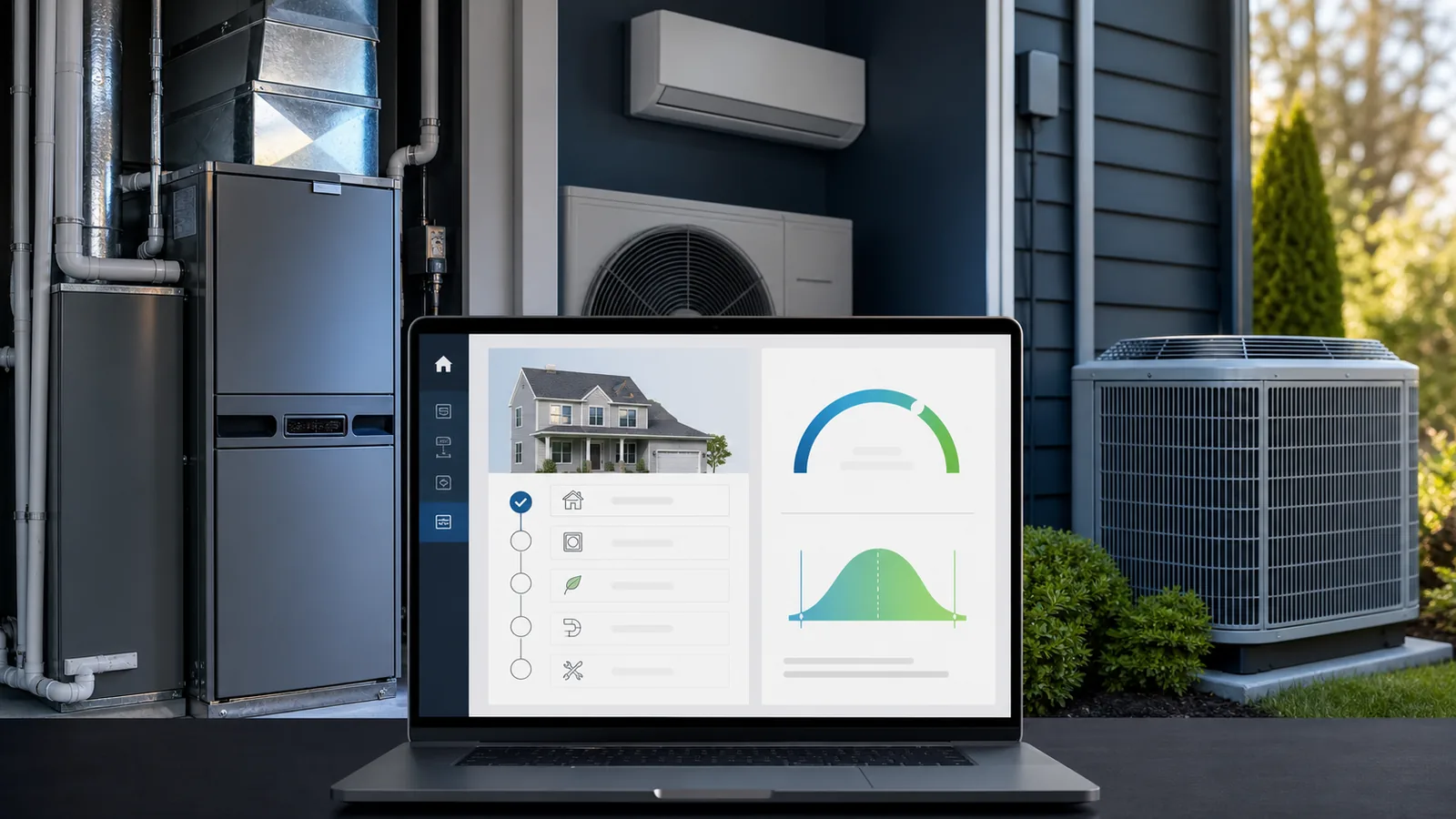
A HVAC replacement and installation estimator is custom software connected to a website, not just a form. It must help homeowners, comfort advisers, sales staff, and administrators provide project context, see an educational planning range, and schedule a qualified equipment consultation. Development cost depends on the rules, data, permissions, integrations, administration, security, and testing behind the screens.
A reliable estimate starts with discovery because the same visible interface can hide very different logic. A prototype with fixed sample values is not equivalent to a production system with live data, account controls, audit needs, error handling, and business ownership.
What determines development cost?
- Home size, type, location, and climate context
- Existing system, fuel, duct, electrical, and access conditions
- Equipment type, capacity, efficiency, and accessories
- Labor, permit, disposal, tax, rebate, and financing rules
- Range, disclaimer, and human-review conditions
- Lead routing, scheduling, CRM, and administration
A practical minimum viable version
- Guided property and system questions
- Conditional equipment paths
- Planning range with assumptions
- Upgrade and accessory options
- Consultation request
- Administrator-managed factors and event tracking
Advanced features that increase scope
- Load-calculation data collection without replacing professional sizing
- Equipment catalog and availability
- Regional labor, permit, and rebate data
- Financing or payment scenarios
- CRM and field-service integration
- Saved projects, proposals, and reporting
Discovery and rule design
Before design begins, write the inputs, outputs, formulas, permissions, exceptions, and human decisions. Use worked examples to show expected results. Mark rules that are estimates, business policy, external data, or regulated decisions.Complexity increases when one answer changes many later choices, when data differs by location or customer, or when staff must approve, override, and explain the result.
User experience and accessibility
- Ask one understandable group of questions at a time
- Explain why unusual information is needed
- Show progress and allow safe correction
- Validate inputs with helpful messages
- Design for keyboard, screen, contrast, and mobile use
- Keep assumptions and next steps close to the result
Security, privacy, and ownership
Use business-owned accounts, least-privilege access, protected credentials, encrypted transport, documented retention, backups, and recovery. Collect only what the workflow needs. Sensitive or regulated data requires specialist review appropriate to the business and jurisdiction.Testing and acceptance criteria
- Create test cases for common, boundary, invalid, and high-value scenarios
- Compare calculations with approved manual examples
- Test permissions for every role
- Simulate unavailable services and failed integrations
- Check mobile, browser, accessibility, email, and PDF output
- Verify analytics without exposing sensitive inputs
- Record who approves the production release
Important limitation
An online HVAC estimator must not present itself as a final load calculation, code review, or binding installation quote. Site conditions, safety, equipment selection, permits, and professional assessment can change the final scope.One-time and ongoing costs
- Discovery, design, development, and data preparation
- Hosting, databases, email, maps, PDFs, or third-party APIs
- Security updates and dependency maintenance
- Rule, price, catalog, or content updates
- Monitoring, backups, support, and incident response
- Future integrations and workflow changes
Prepare for a free estimator project estimate
To estimate a HVAC replacement and installation estimator, prepare the audience, desired output, questions, formulas, sample calculations, integrations, administrator needs, privacy constraints, and launch target. Gain Gati can use this material to provide a free initial planning range.The final scope should define ownership, source data, assumptions, recurring services, acceptance tests, and who maintains the rules. A transparent estimate explains both the visible interface and the system responsibilities behind it.